Egg Freezing: The Complete, Honest Guide to the Process, Success Rates and Costs
A complete guide to egg freezing: procedure, success rates by age, costs and UK storage rules, explained clearly.
Read More

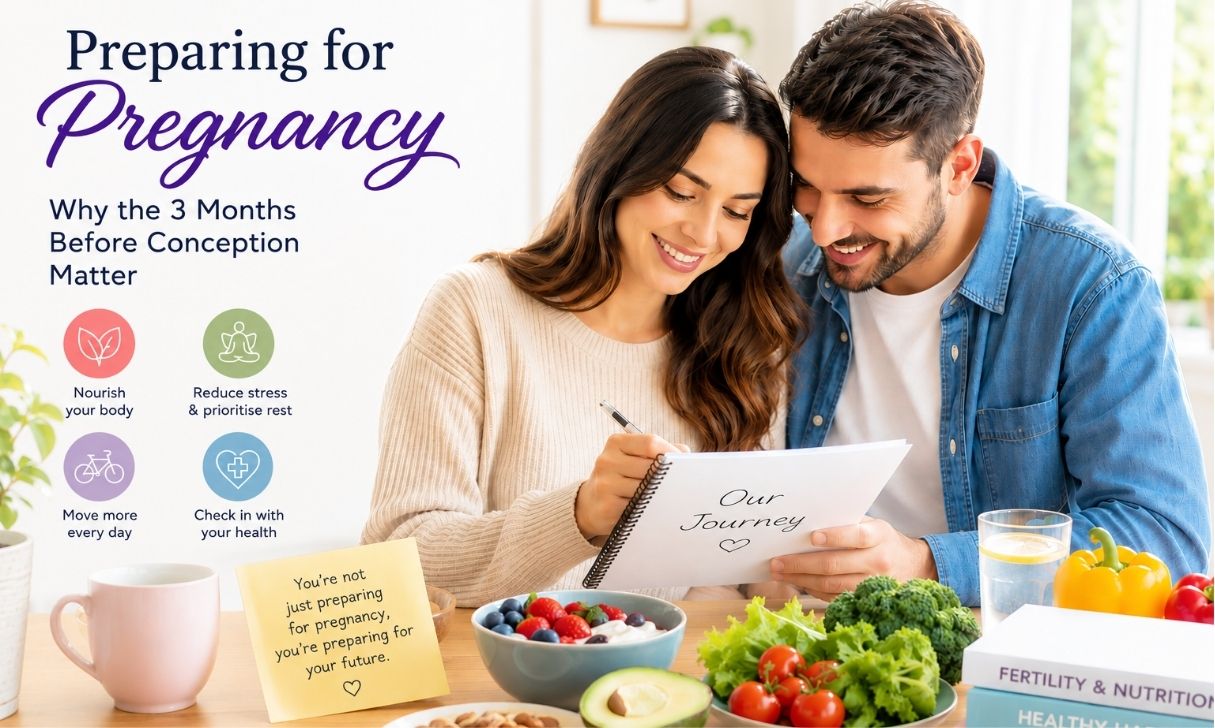


If you are thinking about trying for a baby, the most important preparation may begin before you stop contraception or start tracking ovulation. From a fertility perspective, the three months before conception are particularly important.
During this time, sperm cells are developing, egg follicles are maturing, and your overall health can influence fertility and future pregnancy outcomes. Preparing for pregnancy is not just about timing intercourse. It is about giving both partners the best possible foundation for conception and a healthy pregnancy.
Many couples focus on the month they hope to conceive. However, fertility specialists often encourage couples to look further back.
The health choices you make today may influence the quality of sperm and eggs that contribute to a future pregnancy several weeks or months later.
Sperm production is a continuous process, but it takes approximately 70 to 90 days for sperm cells to fully develop.
This means that factors such as smoking, alcohol consumption, obesity, poor nutrition, illness, certain medications, and lifestyle habits may affect sperm quality long before conception occurs.
This is one reason why male fertility matters just as much as female fertility when preparing for pregnancy.
If you would like to learn more about how sperm health affects conception, read our article on male fertility and what every man and couple should know.
Many people assume that an egg simply appears at ovulation each month. In reality, ovarian follicles begin developing well before an egg is released.
Although women are born with their lifetime supply of eggs, the process of follicle growth and maturation occurs over several months before ovulation.
This is why healthy lifestyle choices before conception can be an important part of preconception care.
The biological foundations of pregnancy are being established before a positive pregnancy test.
Preparing for pregnancy gives couples an opportunity to:
Maintaining a healthy weight can improve reproductive health for both men and women. Learn more about the relationship between body weight and fertility.
Preparing your body for pregnancy does not require perfection.
Simple, sustainable habits can make a meaningful difference:
For practical guidance, explore our article on evidence-based nutrition to support fertility.
You may also benefit from our lifestyle modification support for fertility and preconception health.
If either partner has a medical condition such as thyroid disease, diabetes, epilepsy, high blood pressure, or autoimmune disease, it is important to seek medical advice before trying for a baby.
NICE and NHS guidance recommend reviewing medical conditions before conception to help optimise fertility and pregnancy outcomes.
Many medications are completely compatible with pregnancy planning. However, some medicines may require adjustment before conception.
Do not stop prescribed medications without professional advice.
A preconception consultation can help ensure that any treatment plan supports both your health and future pregnancy goals.
The NHS recommends taking folic acid before conception and continuing through early pregnancy.
Ideally, supplementation should begin before you start trying for a baby, allowing your body time to build adequate levels.
One of the most common sources of anxiety for couples is comparison.
It can often seem as though everyone else is getting pregnant effortlessly. The reality is often very different.
Every couple's fertility journey is unique.
In clinical practice, some couples with known fertility concerns conceive quickly, while others with no obvious risk factors may take longer than expected.
Comparing your experience with friends, family members, or stories online rarely provides a helpful benchmark.
According to NICE guidance:
These statistics can be reassuring for couples who are still early in their journey.
Age is one of the factors that can influence fertility outcomes. Read more about fertility after 35 and how age affects egg quality and ovarian reserve.
If you have been trying to conceive without success, seeking advice does not mean something is necessarily wrong.
A fertility assessment can help identify potential issues and provide reassurance where appropriate.
Learn more about what happens during a fertility evaluation and why it is often the first step towards parenthood.
You can also explore our fertility evaluation services if you would like a personalised assessment.
One of the most common fertility myths is that every woman has a 28-day cycle and ovulates on day 14.
In reality, menstrual cycles vary considerably.
A healthy cycle may be shorter or longer than 28 days.
Cycle length can vary between women and even between cycles for the same woman.
Understanding your own cycle is often more helpful than relying on generic fertility advice.
No.
Ovulation timing depends on cycle length and individual hormonal patterns.
Assuming that everyone ovulates on day 14 can lead to unnecessary confusion and stress.
Tracking menstrual cycles can help you understand:
Our ovulation calculator may be a useful starting point when learning more about your cycle.
When preparing for pregnancy, it is easy to become focused on timelines, statistics, and uncertainty.
Instead, focus on factors within your control:
The goal is not perfection.
The goal is preparation.
Preparing for pregnancy starts before conception.
The three months before trying for a baby offer an opportunity to optimise health, review medical conditions, understand fertility, and build the foundations for a healthy pregnancy.
Most importantly, remember that fertility journeys are highly individual.
Protect your peace of mind, focus on your own biology rather than someone else's timeline, and give your body the time it needs.
A: Ideally, preparation should begin at least three months before trying to conceive. This allows time to optimise health, review medications, and start recommended supplements such as folic acid.
A: Sperm development takes approximately 70 to 90 days, and egg follicles mature over several months before ovulation. Health choices during this period may influence fertility and pregnancy outcomes.
A: Yes. Male fertility is an important part of conception, and sperm quality can influence the likelihood of pregnancy.
A: Yes. More than 80% of couples conceive naturally within one year, and over 90% within two years.*
A: No. Ovulation timing varies depending on cycle length and individual hormonal patterns.
A: NICE generally recommends fertility assessment after 12 months of trying to conceive without success, although earlier review may be appropriate depending on age, medical history, or known fertility concerns.
If you are planning a pregnancy, have questions about your fertility, or would like personalised guidance before trying to conceive, our team is here to help.
You can book a fertility consultation with a member of the JIVA Fertility team to discuss your individual circumstances and receive evidence-based advice tailored to your needs.
Disclaimer: This article is intended for educational purposes and does not replace individual medical advice. Please consult a healthcare provider for assessment and treatment decisions.
A complete guide to egg freezing: procedure, success rates by age, costs and UK storage rules, explained clearly.
Many women in the UK wait years for a PCOS diagnosis. Here is what the evidence shows about the delay, why it happens, and what evidence-based care looks like.