Egg Freezing: The Complete, Honest Guide to the Process, Success Rates and Costs
A complete guide to egg freezing: procedure, success rates by age, costs and UK storage rules, explained clearly.
Read More

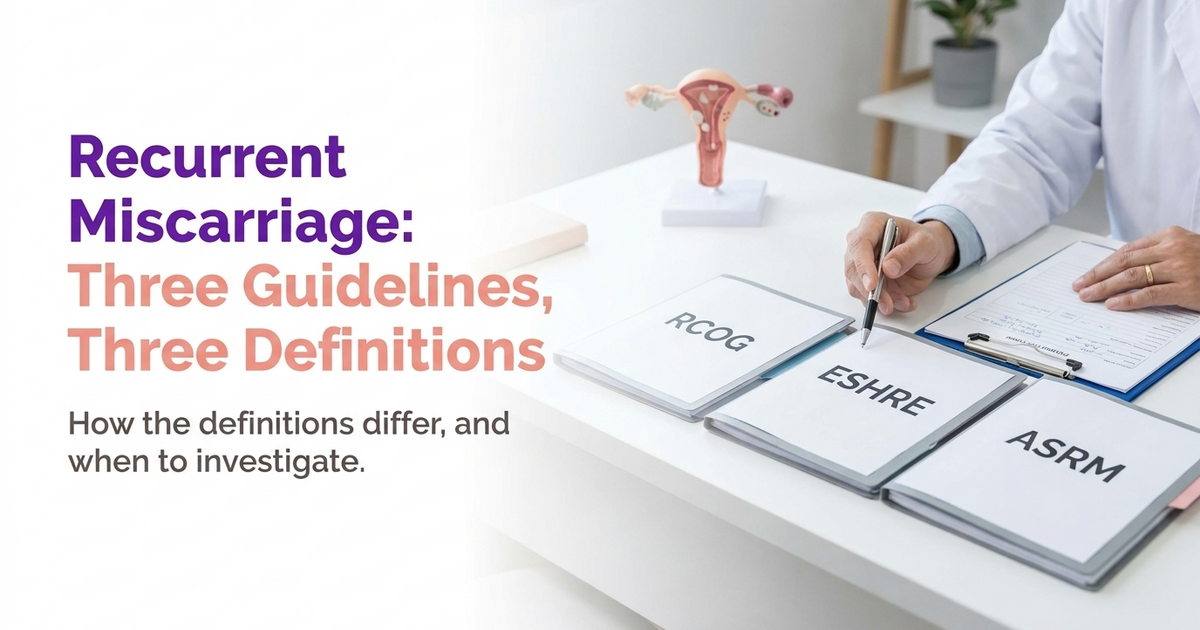


If you have searched for a recurrent miscarriage definition online, you have probably found three different answers. The Royal College of Obstetricians and Gynaecologists (RCOG) says three losses. The European Society of Human Reproduction and Embryology (ESHRE) says two. The American Society for Reproductive Medicine (ASRM) also says two, but changed an important detail in 2026. None of these bodies is wrong: they are answering slightly different clinical questions. This guide sets out what each definition actually says, why they differ, and, most importantly, when you should ask for investigation, whether you have had one loss, two, or three.
Recurrent miscarriage is not one universally agreed threshold. It is defined differently by the UK's RCOG, Europe's ESHRE, and the US's ASRM, and the difference in number of losses, two versus three, has a real effect on when investigations start.
The RCOG's Green-top Guideline No. 17, updated in 2023, defines recurrent miscarriage as three or more first-trimester pregnancy losses. This is the definition used in UK clinical practice, including at JIVA. Two details often get missed: the losses do not need to be consecutive, and they do not need to be with the same partner. The 2023 update removed both requirements, reflecting that pathology causing recurrent loss, such as antiphospholipid syndrome, would not be affected by a change of partner. RCOG also counts pregnancy from conception, so very early biochemical losses, confirmed by a positive pregnancy test alone, are included in the total. RCOG Green-top Guideline No. 17 puts the prevalence of three or more first-trimester losses at around 0.7% of women.
ESHRE, the main European professional body for reproductive medicine, sets a lower threshold: recurrent pregnancy loss is two or more losses, again not necessarily consecutive. This means clinical evaluation can reasonably start after a second loss under ESHRE's guidance, a full pregnancy earlier than the strict RCOG definition would suggest.
ASRM issued its first updated committee opinion on recurrent pregnancy loss in over a decade in 2026. Like ESHRE, ASRM defines recurrent pregnancy loss as two or more losses that do not need to be consecutive. The notable change in the 2026 opinion is which pregnancies count towards that total: the previous ASRM position, from 2012, only counted losses confirmed by ultrasound or examination of pregnancy tissue, excluding very early biochemical losses. The 2026 update now recognises pregnancies confirmed by a positive blood or urine test alone, bringing the ASRM definition closer to RCOG's on this specific point, even though the two bodies still disagree on the headline number of losses required.
The practical effect of a two-loss threshold, used by both ESHRE and ASRM, is earlier access to investigation than the UK's three-loss RCOG definition would strictly allow. That does not mean patients in the UK are left waiting. RCOG's own guidance encourages clinicians to use clinical discretion and offer targeted investigation after two losses where there is a specific reason for concern, rather than applying the three-loss rule rigidly in every case. All three current definitions now agree on one point that matters practically: non-consecutive miscarriages count towards your total just as consecutive ones do, so a gap of months or years between losses, or a change of partner, does not reset the count.
It is also worth being clear about the difference between a biochemical and a clinical pregnancy loss. A biochemical pregnancy is one confirmed only by a positive blood or urine test, before it is visible on ultrasound. A clinical pregnancy loss is one confirmed by ultrasound or, in later loss, by examination of pregnancy tissue. Whether biochemical losses count towards your total affects how many losses you may have had under each definition, which is exactly where RCOG, ESHRE and the newly updated ASRM position now differ least, and where the older ASRM definition differed most.
How many miscarriages before investigations start depends on the number of losses and your individual circumstances, not a single fixed rule.
If you are unsure where you sit on this scale, that uncertainty is itself a reason to have a conversation with a consultant rather than searching for a definitive number online.
Recurrent miscarriage investigations are broadly similar across UK and international guidance, and typically include:
It is important to be honest about what these investigations will and will not find. In around half of cases, no clear cause is identified even after full investigation. That is not a dead end. Unexplained recurrent miscarriage carries a genuinely good prognosis for future pregnancy, covered next, and the absence of a diagnosis does not mean the absence of a path forward.
Recurrent miscarriage management depends entirely on whether investigation finds a specific, treatable cause. Where one is found, such as antiphospholipid syndrome, targeted treatment, typically low-dose aspirin and heparin, meaningfully improves the chance of a successful pregnancy. Where no cause is found, RCOG guidance is clear that supportive care, meaning early pregnancy monitoring and reassurance, gives couples with unexplained recurrent miscarriage a prognosis for a successful live birth in the region of 75% with supportive care alone, without needing empirical drug treatment that lacks strong evidence of benefit.
This is where consultant continuity matters. At JIVA, our consultant team brings more than 25 years of combined experience in reproductive medicine and surgery, and our dedicated recurrent miscarriage evaluation service means you see the same small team at every appointment, rather than starting the conversation again with someone new each time. That continuity is what turns a set of test results into a personalised plan, and a graded, evidence-based approach to when the next steps make sense for you.
If you have had two or more losses and want clarity on the right next step, book a consultation with our dedicated recurrent miscarriage evaluation service.
What counts as a recurrent miscarriage?It depends on which guideline you use. RCOG (UK) defines it as three or more first-trimester losses. ESHRE (Europe) and ASRM (US, 2026 update) both define it as two or more losses. All three agree the losses do not need to be consecutive.
Do miscarriages have to be consecutive to count as recurrent?No. Under the current RCOG, ESHRE and ASRM definitions, losses do not need to happen one after another, and for RCOG they do not need to be with the same partner.
How many miscarriages before investigations start?Full investigation is recommended after three losses under RCOG guidance. Discretionary investigation after two losses is reasonable, especially if you are over 35 or there is a specific clinical concern. After one loss, investigation is not usually indicated.
What tests are done for recurrent miscarriage?Typical investigations include antiphospholipid antibody testing, pelvic ultrasound, thyroid function tests, and parental or pregnancy-tissue karyotyping where a genetic cause is suspected.
What are my chances of a successful pregnancy after recurrent miscarriage?Even without an identified cause, RCOG guidance puts the chance of a successful future pregnancy with supportive care alone at around 75%. Where a specific cause is found and treated, such as antiphospholipid syndrome, the outlook can be even better. ( add link for recurrent miscarriage calculation )
Disclaimer
We make every reasonable effort to ensure that the information contained in this article is accurate and up to date at the time of publication. However, medical knowledge, clinical guidelines, research findings, and statistics may change over time, and inadvertent errors or omissions may occur.
The information provided is intended for general educational purposes only and should not be relied upon as a substitute for professional medical advice, diagnosis, or treatment. Readers should consult a qualified healthcare professional regarding their individual circumstances.
Where statistics, research findings, or third-party information are referenced, we aim to cite reputable sources. We do not guarantee the completeness, accuracy, or continued availability of information obtained from third-party sources.

A complete guide to egg freezing: procedure, success rates by age, costs and UK storage rules, explained clearly.

Many women in the UK wait years for a PCOS diagnosis. Here is what the evidence shows about the delay, why it happens, and what evidence-based care looks like.