How Long Does It Take to Get a PCOS or PMOS Diagnosis?
Many women in the UK wait years for a PCOS diagnosis. Here is what the evidence shows about the delay, why it happens, and what evidence-based care looks like.
Read More

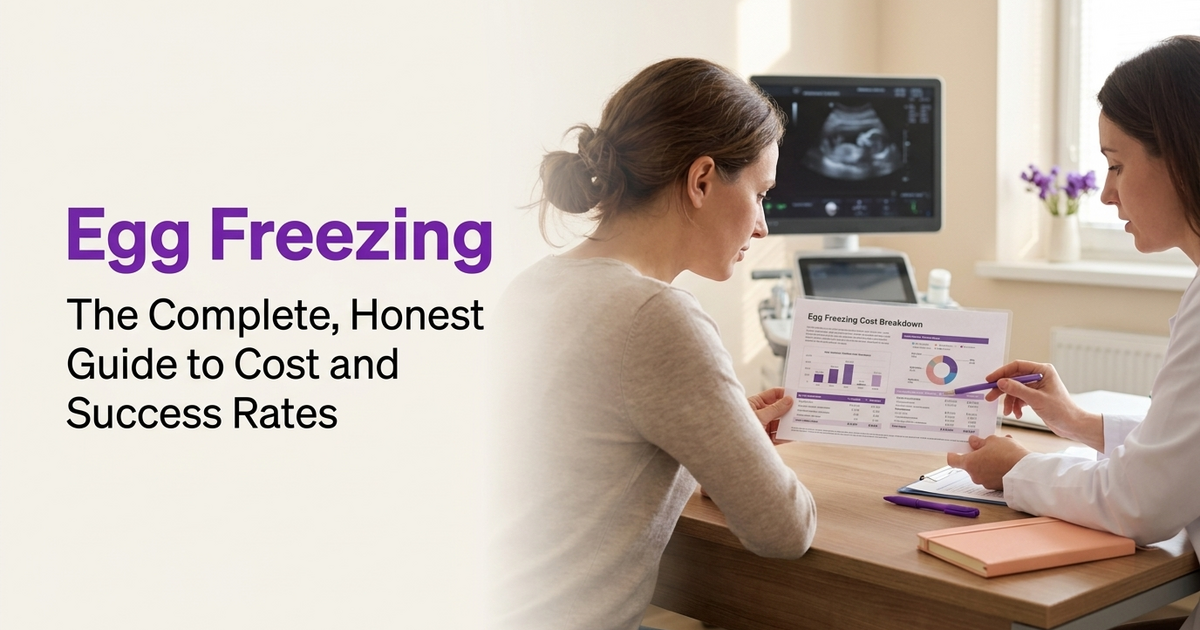


Egg freezing, known clinically as oocyte cryopreservation, is the process of collecting eggs from individuals born with ovaries, freezing them unfertilised, and storing them for possible use later. It differs from IVF/ICSI treatment in one important way: with IVF/ICSI treatment, eggs are collected and fertilised straight away, then the resulting embryo is either transferred to achieve pregnancy or frozen for future use. With egg freezing, nothing is fertilised at the point of freezing. The eggs themselves go into storage, and fertilisation only happens if and when you come back to use them.
Individuals consider egg freezing for several different reasons. Some are managing the well-documented decline in egg quantity and quality that comes with age and have not yet met a partner or feel ready to have children. Others are about to start medical treatment, such as chemotherapy or gender affirming hormone therapy, that could affect their fertility, and want to preserve options beforehand. A smaller group freeze eggs alongside a diagnosis like endometriosis or a family history of early menopause. Whatever the reason, the decision usually comes down to the same question: what are the realistic odds it leads to a baby and what would this actually cost?
Key takeaways
An egg freezing cycle runs over roughly two to four weeks and follows three broad stages:
Controlled ovarian stimulation: you self-administer hormone injections for around 10 to 14 days to encourage your ovaries to develop multiple eggs in a single cycle, rather than the one egg a natural cycle produces. This needs to be controlled so that you produce appropriate number of eggs to reduce the complications.
Monitoring: you attend the clinic for ultrasound scans (+ occasionally blood tests) so your consultant can track follicle (egg containing sacs) growth and adjust your medication dose.
Egg collection and Freezing: once the follicles are mature, a trigger injection is given and the eggs are retrieved in a short procedure under sedation, then frozen the same day using a rapid-freezing technique called vitrification.
The number of eggs collected in that one cycle matters more than most people expect, because not every frozen egg will survive thawing, fertilise successfully, or lead to a viable embryo later. This is why your consultant will talk to you about your individual ovarian reserve, usually measured through an AMH blood test and an antral follicle count on ultrasound, before your cycle even begins. Some individuals need more than one cycle to bank a number of eggs that gives them a realistic chance later on.
The evidence is clear on one point: Your age at freezing is the single biggest factor in whether frozen eggs go on to result in a live birth.
The HFEA publication from September 2018, that covered the trends and figures relating to egg freezing and the use of thawed eggs in fertility treatment in the UK from 2010 to 2016, the average live birth rate from own frozen eggs was around 18 percent per thaw cycle.
A recent study, published in Reproductive BioMedicine Online journal in 2024, followed patients at a single UK centre over 15 years and gives a fuller picture of how sharply that average splits by age, and found outcomes (see below table) that were "comparable with those nationally recorded in routine IVF treatment" for individuals who froze eggs before the age of 36 years. The gap between the under-36 group and the over-40 group is large enough that it should factor directly into your decision about timing, not just whether to freeze at all.
| Age at freezing | Cumulative live birth rate after thaw (UK study, 2008 to 2022) |
|---|---|
| Under 36 | 45% |
| 36 to 40 | Meaningfully lower than under-36 group |
| Over 40 | Around 5% |
A live birth rate "per thaw cycle" or "per embryo transferred" is not the same as your overall lifetime odds if you bank a larger number of eggs across more than one collection cycle, and it is not a promise for any individual. Egg freezing preserves a chance at a future pregnancy; it does not guarantee one, whatever your age.
The HFEA Dashboard provides useful information about the number of egg freezing and egg thawing cycles in the UK by year from 2008 to 2024. 27,490 individuals with an average age of 35 years have stored eggs during this time and only 4,185 individuals (15.2%) have returned to use them at an average age of 40 years.
A UK study following 2,171 patients between 2008 and 2022 found that only 299 of them, about 14 percent, had returned to thaw and use their eggs by the time of reporting. Put another way, roughly 6 in 7 individuals who freeze their eggs have not yet come back to use them.
There are several reasonable explanations for this. Some women conceive naturally in the meantime and never need their frozen eggs. Others are still waiting for the right time, a partner, or financial readiness. And for some, the eggs simply remain an unused, paid-for option in storage. None of this means egg freezing was the wrong choice for those women; it means the decision to freeze and the decision to use are genuinely separate, and it is worth going in with realistic expectations about which category you might fall into, rather than assuming you will definitely return to use what you have banked.
This figure is also relevant to the parliamentary scrutiny egg freezing is currently under. The UK Parliament's Women and Equalities Committee opened an inquiry into egg donation and freezing, examining whether women receive sufficient information about the process, health impacts and long-term consequences before they commit.
When you eventually return to use your frozen eggs, they cannot be fertilised the way a conventional IVF treatment cycle fertilises fresh eggs. As the freezing process toughens the egg's outer coating (the zona pellucida) enough that sperm may not penetrate it naturally, the eggs that have been frozen and thawed must be fertilised using ICSI, (intracytoplasmic sperm injection),where a single sperm is injected directly into each egg.
If you are weighing up ICSI against conventional IVF fertilisation more broadly, including how each is used outside egg freezing, our guide to IVF versus ICSI sets out the difference and when each is used.
Since 1 July 2022, UK law allows you to store eggs, sperm or embryos for up to 55 years from the date they were first frozen, as long at 10 yearly increments. Before that date, most people were limited to 10 years, unless they had a medical reason such as premature infertility or have had a treatment likely to affect their fertility.
That 10-year renewal is not a formality to skip. If consent lapses, storage cannot lawfully continue, and clinics are required to act on eggs that fall out of consented storage. Before you freeze, ask your clinic exactly how and when they will contact you about renewal, and what happens to your eggs if you do not respond.
Ovarian stimulation carries a real, generally manageable, medical risk: ovarian hyperstimulation syndrome, or OHSS. Most cases are mild and settle on their own, but you should know what to flag and when to seek help. In severe cases, which is reported to be in around 1 in 1000 treatment cycles in the UK in recent years, OHSS needs management in a hospital setting, so your clinic should talk you through the symptoms to watch for and monitor you closely with scans and blood tests.
The egg collection procedure carries a very small risk of serious pelvic infection or excessive bleeding, which is generally quoted to be around 1 in 500.
Beyond the physical process, the biggest consideration is emotional and financial: egg freezing is a meaningful outlay of money and hope for a chance, not a guarantee, at a future pregnancy. A good consultation should cover your individual ovarian reserve, a realistic estimate of how many eggs you are likely to collect, and what that number of eggs statistically means for your odds later, rather than a generic pitch.
The full cost of egg freezing is rarely the single number on a clinic's homepage. According to the data from the HFEA (publication date 08 April 2016) the average cost of the collection and freezing cycle itself is around 3,350 pounds, with medication adding a further 500 to 1,500 pounds depending on your individual dose and response. That headline figure is what most comparison sites and clinic pricing pages quote, and it does not include everything you will eventually pay.
| Cost component | HFEA Publication (08 April 2016) | Typical Cost in the UK (2026) |
|---|---|---|
| Egg collection and freezing cycle | About £3,350 | Around £5,000, can be up to £6,100-£7,300 per cycle |
| Stimulation medication | £500 to £1,500 | around £1,200, but can be up to £1,800 |
| Annual storage | £125 to £350 per year | Can be up to £540 per year |
| Thaw and embryo transfer (at a later date when you wish to use them) | About £2,500 on average | from £2,200 to £4,600 per cycle (may not include the medications) |
| Realistic all-in total (egg freezing one cycle plus one year of storage and one thaw and embryo transfer cycle) | Roughly £7,000 to £8,000 | can be around £10,000 to £13,000 |
Storage fees are the part that catches people out. They are small individually but compound every year your eggs sit in storage, and are easy to overlook when comparing headline prices.
The thaw and transfer cost is easy to forget entirely too, since it may be years away and does not appear on an initial quote at all.
The true all-in cost of one egg freezing cycle in the UK can be around £10,000 to £13,000, not the £3,000 to £3,500 headline figure advertised by some.
There is no single right answer, only the right answer for your circumstances, your ovarian reserve, and what you are hoping to preserve options for. Before booking a cycle, it is worth asking your consultant a few direct questions: What does my AMH and antral follicle count suggest about my ovarian reserve? How many eggs would I realistically need to collect for a meaningful chance later? What is the full, itemised cost, including storage and an estimated thaw and transfer fee? And what would happen if I never came back to use the eggs?
We take an evidence-based, consultant-led approach to fertility preservation, because a decision this personal deserves a full and clear picture rather than a headline price. If you are weighing up whether egg freezing is right for you, we would rather talk you through your own ovarian reserve and realistic options than sell you a number.
Speak to our consultant-led team about your fertility preservation options and what egg freezing would realistically involve for you. Book a consultation.
What is the success rate of frozen eggs?
HFEA data puts the national average live birth rate from a woman's own frozen eggs at around 18 percent per thaw cycle. Age at freezing matters enormously: UK research following patients from 2008 to 2022 found a 45 percent cumulative live birth rate for eggs frozen before age 36, falling to around 5 percent for eggs frozen after 40.
How long can you store frozen eggs in the UK?
Since 1 July 2022, you can store eggs for up to 55 years from the date they were first frozen, as long as you renew your storage consent every 10 years. Before that law changed, most people were limited to 10 years unless they had a qualifying medical reason.
Do you need ICSI to use frozen eggs?
Yes. Frozen and thawed eggs must be fertilised using ICSI, where a single sperm is injected directly into the egg, because the freezing process toughens the egg's outer coating enough that sperm cannot reliably penetrate it on its own.
What happens if you never use your frozen eggs?
Many women do not: a UK study found only around 14 percent of women who froze their eggs privately had returned to thaw and use them. Your eggs remain in storage, (provided annual storage fees have been paid) under your consent, renewable every 10 years up to a maximum of 55 years, until you decide to use them or donate or choose to have them removed from storage.
How much does it really cost to freeze your eggs in the UK?
Realistically, £10,000 to £13,000 all in for one cycle, once you include the egg collection and freezing cycle, medications, at least a year of storage, and thawing of eggs, ICSI treatment and transferring the resulting embryos.
Disclaimer
We make every reasonable effort to ensure that the information contained in this article is accurate and up to date at the time of publication. However, medical knowledge, clinical guidelines, research findings, and statistics may change over time, and inadvertent errors or omissions may occur.
The information provided is intended for general educational purposes only and should not be relied upon as a substitute for professional medical advice, diagnosis, or treatment. Readers should consult a qualified healthcare professional regarding their individual circumstances.
Where statistics, research findings, or third-party information are referenced, we aim to cite reputable sources. We do not guarantee the completeness, accuracy, or continued availability of information obtained from third-party sources.
Many women in the UK wait years for a PCOS diagnosis. Here is what the evidence shows about the delay, why it happens, and what evidence-based care looks like.
A step-by-step guide to IVF treatment in the UK, from your first consultation to the pregnancy test, explained by JIVA Fertility's consultant-led team.