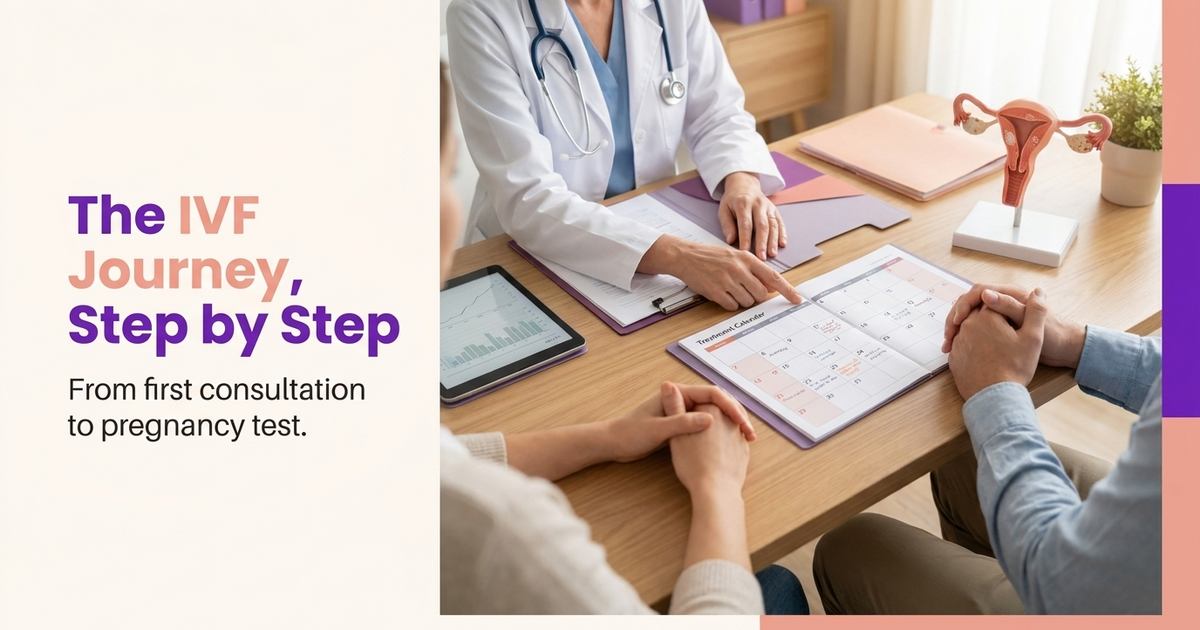
The IVF/ICSI process step by step runs through different stages: a first consultation and fertility assessment, pituitary suppression, ovarian stimulation, ovulation trigger, egg collection, luteal phase support, fertilisation (IVF or ICSI), embryo development and transfer, then a two week wait ending in urine pregnancy test or a clinic blood test, and a full cycle depending on the protocol may take between five to eight weeks from your first injection to your pregnancy test result.
Key takeaways
- A full IVF cycle, depending on the protocol usually runs five to eight weeks from the start of IVF medications to the pregnancy test result, though the run-up (assessment and planning) often adds several more weeks.
- Ovarian stimulation involves 9 to 14 days of daily hormone injections, monitored with regular ultrasound scans and blood tests. Pituitary suppression to stop your pituitary hormones interfering in the treatment cycle is usually done within this period, but sometimes, may need to be commenced before the ovarian stimulation.
- Trigger injection is needed for the final maturation of the follicles (egg containing sacs)
- Egg retrieval procedure is often undertaken under conscious sedation.
- Fertilisation of the egg happens either through standard IVF (mixing of sperm and an egg in a petri dish in the lab) or ICSI, where a single sperm is injected directly into each mature egg, and the embryo development is monitored.
- Embryo transfer does not require sedation: a thin catheter carrying the chosen embryo is passed through the cervix into the womb under ultrasound guidance, a procedure that takes a matter of minutes
- The pregnancy test is performed 14-18 days after the egg collection with a home urine test. Occasionally a blood test will be performed.
- Embryos not used in the current treatment can often be frozen for future treatment if they meet good quality standards.
What Is IVF and How Long Does the Whole Process Take?
IVF, in vitro fertilisation, is a treatment where eggs are collected from the ovaries and fertilised with sperm in a laboratory, and the resulting embryo is transferred into the womb to try to establish a pregnancy. It is the most established form of assisted conception, and understanding what each stage actually involves makes the decision to start treatment, and the weeks that follow, considerably less daunting.
From the day medications (usually daily injections) begin to the day of your pregnancy test, most cycles run five to eight weeks. Add the initial consultation and testing beforehand, and the realistic timeline from first appointment to result is closer to two to three months. The stages, in order, are:
Initial Assessment and Cycle Planning
Your first consultation is where your consultant reviews your medical history, any previous fertility investigations, and what you and your partner (if applicable) have already tried. From there, they typically order a small set of tests: a pelvic ultrasound to count your antral follicles (AFC), an AMH blood test to estimate your ovarian reserve, and a semen analysis where male-factor fertility is relevant.
At JIVA Fertility, this first appointment is also where our consultant-led, same-team model starts. Our consultant team brings 25+ years of combined medical experience in reproductive medicine and surgery, and the consultant you meet at this first appointment is the same person guiding you throughout your treatment at each stage. For a fuller walkthrough of what to expect at this stage, see what happens during your first fertility consultation.
This appointment is also where the practical decisions get made: which stimulation protocol suits you, whether standard IVF or ICSI is more likely to be recommended based on the semen analysis. Our specialists assess your fertility and create a personalised treatment plan that is best suitable for you. We use prediction models to estimate the chances of treatment resulting in a healthy baby.
Suppressing your natural menstrual cycle hormones (Pituitary suppression or down regulation)
You will take daily injections to temporarily suppress your own hormones interfering in the treatment cycle. This may start during your current cycle or in the previous cycle.
Ovarian stimulation
You will be taught to administer daily gonadotropin injections to stimulate the ovaries to produce multiple follicles (egg containing sacs). Most women need injections for 9-14 days and this stage is closely monitored by doing trans-vaginal (internal) ultrasound scans (+/- blood tests).
Trigger injection
When follicles reach the right size, a trigger injection (hCG or GnRH analogue) is given 34-36 hours before the egg retrieval procedure, to help mature eggs in the follicles.
Egg retrieval or collection (Trans-vaginal Oocyte Retrieval)
You will be given conscious sedation and pain killers through your vein. You do not feel any pain and you generally do not remember about it afterwards. A hollow needle attached to the ultrasound scan probe is passed through the vagina to aspirate eggs from the ovaries. Not all the eggs come out from all the follicles. The procedure takes about 30 minutes, and you will be discharged home the same day after 2-4 hours in the unit. You may experience some period-like cramps, feel a little sore and bruised and/or experience a small amount of bleeding for few days. Very occasionally, the procedure to retrieve eggs may have to be performed trans-abdominally (through your abdomen).
Immediately afterwards, the eggs are handed to the embryology lab, where they are assessed for maturity while your partner's sperm sample (or donor sperm, if applicable) is prepared for fertilisation the same day.
Fertilisation - IVF or ICSI
There are two ways eggs are fertilised in the lab:
In standard IVF insemination, prepared sperm is placed alongside each egg in a dish and fertilisation happens on its own. In ICSI (intracytoplasmic sperm injection), an embryologist injects a single sperm directly into each mature egg, a technique used where sperm count, movement or shape make natural fertilisation in a dish less likely to succeed.
The technique is chosen for a reason: ICSI exists to work around a specific sperm-quality problem or in some other cases, not as a routine upgrade to standard IVF.
Which approach is used is decided from your semen analysis results at Step 1, and confirmed on the day of egg collection once the sample is assessed. For a fuller comparison of when each is recommended, see IVF vs ICSI: what's the difference and which might you need. Over the following days, the lab checks each egg for normal fertilisation and tracks how the resulting embryos are dividing.
Embryo development
The fertilised eggs (embryos) are cultured in the lab for up to five days, by which point a healthy embryo has developed into a blastocyst, a more advanced stage with two distinct cell types that is linked to better implantation chances than an earlier-stage embryo. Embryologists grade each blastocyst on its appearance to identify the one (or, very occasionally, two) most likely to lead to a successful pregnancy.
Occasionally, we advise against fresh embryo transfer and we suggest you to freeze all the embryos and to come back for a frozen embryo transfer
Embryo transfer
You will be asked to attend with a full bladder, as an abdominal ultrasound scan will be carried out. A speculum is passed inside the vagina and a thin catheter containing the embryo is passed inside the uterus (womb) under ultrasound guidance and the embryo is placed at the top of the womb cavity.
The embryo transfer procedure takes around 10-15 minutes, and your partner will be able to come with you into the embryo transfer procedure room. Sedation is not generally needed; however, some may require gas and air or mild sedation and you will be able to go home straight after the procedure.
Any surplus good quality embryos are stored for future use.
Luteal Phase Support
Progesterone supplements (pessaries and/or injections) help to embryo implant and support early pregnancy. These are used usually until the pregnancy scan, but may be extended in certain circumstances
The two-week wait - Pregnancy Test (if positive, Early Pregnancy Scan)
The stretch between embryo transfer and your pregnancy test, commonly called the two week wait, is often the emotionally hardest part of the whole cycle precisely because there is nothing left to do but wait. Many patients find it easier to plan gentle distractions and avoid symptom-spotting, since early pregnancy symptoms and normal post-transfer sensations overlap heavily and are not a reliable signal either way.
Early pregnancy symptoms and normal post-transfer sensations overlap so heavily that symptom-spotting during the two week wait tells you almost nothing either way.
The test is usually a home urine test, taken around 14-18 days after egg collection. Sometimes a blood test may be advised. You should use the first urine sample in the morning and a good quality urine pregnancy test kit.
Please contact us to advise the outcome of the urine pregnancy test so that we can arrange an early pregnancy scan for you if it is positive or a Review appointment if negative. The early pregnancy ultrasound scan is performed at 6-7 weeks of pregnancy. This will be a trans-vaginal scan and is safe for the developing pregnancy.
Depending on the implantation and development of pregnancy, you may need blood tests and/or repeat scans to ensure that the embryo has implanted in the right place and is developing normally.
If you are considering IVF and want to know what your own treatment plan could look like, book a consultation with our consultant-led team.
What Happens to Embryos That Are Not Transferred
Any suitable embryos beyond the one transferred are not automatically discarded. They can be frozen (vitrified) for future treatment, meaning a second attempt, or a sibling pregnancy later, does not necessarily mean repeating stimulation and egg collection from scratch.
You will be asked to make decisions about these embryos: how long you want them stored, what should happen to them if your circumstances change, and whether you would consider donating unused embryos to research or to another patient. These are not questions you need to answer on the day of transfer, but your clinic should walk you through the options honestly rather than leaving them for later.
How Age and Egg Quality Affect Your Chances at Each Stage
Female age affects IVF/ICSI outcomes at almost every stage above, from how many eggs stimulation produces to how many embryos reach blastocyst stage, but its clearest effect is on the live birth rate per embryo transferred. The HFEA's most recently published age-banded figures, preliminary data on fresh embryo transfers from 2024 UK treatment cycles, published in June 2026, show a clear decline with age:
| Patient age |
Birth rate per embryo transfer |
| 18 to 34 |
38% |
| 35 to 37 |
31% |
| 38 to 39 |
24% |
| 40 to 42 |
16% |
| 43 to 44 |
8% |
IVF birth rate per embryo transfer by patient age, 2024 (preliminary data, not yet validated)
These figures matter most at two points in the process described above: ovarian stimulation, where older patients typically produce fewer mature eggs from the same protocol, and embryo selection at Step 5, where a smaller starting pool of eggs generally means fewer embryos reach blastocyst stage for grading. Neither of these figures is a guarantee for any individual, only a population average, and your consultant will talk through what your own AMH and AFC results at Step 1 suggest for you specifically.
If you are considering IVF and want to know what your own treatment plan could look like, book a consultation with our consultant-led team.
Frequently Asked Questions
How long does IVF take from consultation to pregnancy test?
Most cycles run five to eight weeks from the start of medications (usually daily injections) to the pregnancy test result. Adding the initial consultation and fertility assessment beforehand, the realistic timeline is closer to two to three months from your first appointment.
What is the difference between IVF and ICSI?
In standard IVF, sperm and eggs are placed together in a dish in an IVF laboratory and allow natural process for one sperm to enter the egg for fertilisation. In ICSI, an embryologist injects a single sperm directly into each mature egg, an approach used where sperm quality makes natural fertilisation in a dish less likely to succeed.
Is egg collection painful?
Egg collection is done under conscious sedation when a sedative and a pain killer is given, so you should not feel the procedure itself. Afterwards, mild cramping and spotting are common and usually settle within a day or two.
What happens to unused embryos?
Suitable embryos beyond the one transferred can usually be frozen for a future cycle. You will be asked to decide how long you want them stored and what should happen to them if your plans change.
Does NHS funding work differently from private IVF?
NHS-funded IVF eligibility and cycle entitlement vary by local area and are generally more restrictive than private treatment, which is one reason many patients in Yorkshire choose a private, consultant-led pathway instead.
Disclaimer
We make every reasonable effort to ensure that the information contained in this article is accurate and up to date at the time of publication. However, medical knowledge, clinical guidelines, research findings, and statistics may change over time, and inadvertent errors or omissions may occur.
The information provided is intended for general educational purposes only and should not be relied upon as a substitute for professional medical advice, diagnosis, or treatment. Readers should consult a qualified healthcare professional regarding their individual circumstances.
Where statistics, research findings, or third-party information are referenced, we aim to cite reputable sources. We do not guarantee the completeness, accuracy, or continued availability of information obtained from third-party sources.