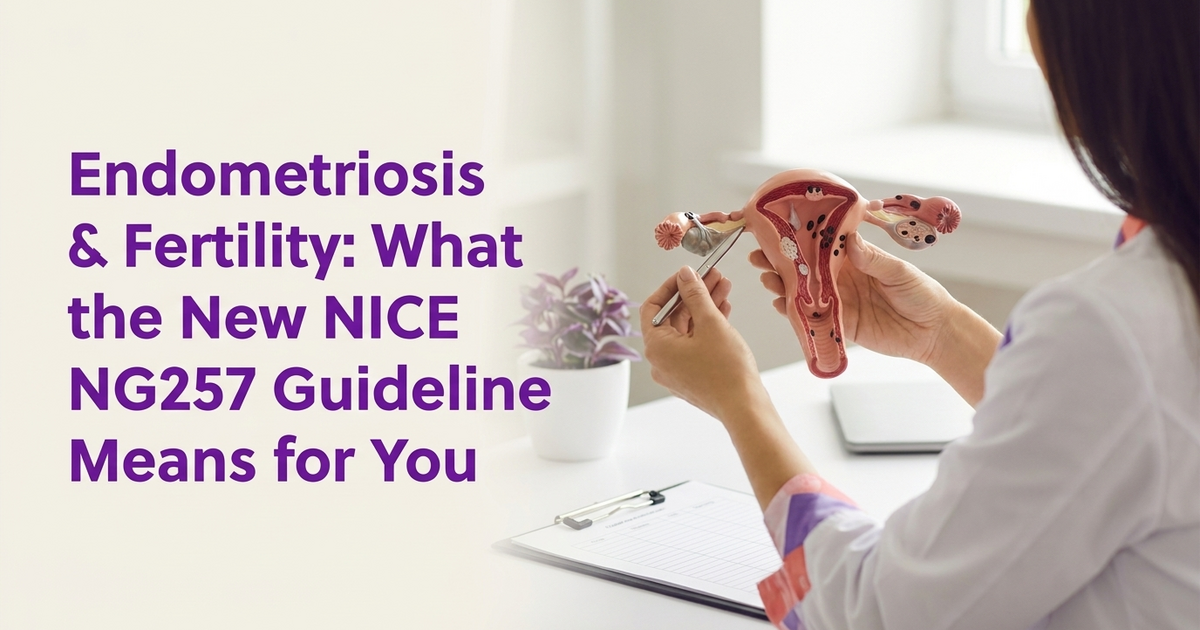
Endometriosis has just been given its own fertility treatment pathway for the first time. The National Institute for Health and Care Excellence (NICE) guideline NG257, published in March 2026, sets out a dedicated route for people trying to conceive with endometriosis. The change means endometriosis is no longer folded into the broader infertility category, so the route you are offered should now reflect the condition itself, not a generic label.
Key takeaways
- The National Institute for Health and Care Excellence (NICE) published NG257, "Fertility problems: assessment and treatment," in March 2026, with a dedicated section for endometriosis-related fertility problems for the first time.
- Endometriosis-related infertility now has a pathway built around the condition.
- Fertility management options for endometriosis include expectant management, surgical treatment or assisted reproductive techniques (fertility treatments such as IUI or IVF).
- Which route suits you depends on individual factors: how long you have been trying to conceive, your symptoms and severity of endometriosis, age, ovarian reserve, and whether there is a male-factor component too.
If endometriosis may be affecting your fertility, book a consultation with one of our Consultants to talk through which stage of this pathway fits your circumstances.
What has Changed about Endometriosis in the New NICE guideline on Fertility Problems: Assessment and Treatment
The National Institute for Health and Care Excellence (NICE), gave endometriosis its own dedicated fertility pathway for the first time in NG257, published in March 2026. NICE sets clinical guidance for the NHS in England and Wales; its updated guideline covers the assessment and treatment of fertility problems generally, and now gives endometriosis its own section rather than folding it into other categories.
Endometriosis is often diagnosed years after symptoms start, and being routed through a generic infertility label on top of that delay added a further layer of vagueness to an already difficult process.
For anyone who was previously grouped under unexplained infertility because endometriosis had not been fully worked into their diagnosis, this is a meaningful shift, not just a wording change. It changes which pathway you are actually offered.
The New NICE Fertility Guideline: Management of Endometriosis and Fertility, Step by Step
The NICE NG257 asks clinicians to individualise the route rather than apply one default, weighing five factors: how long you have been trying to conceive, your symptoms and the severity of endometriosis, your age, your ovarian reserve (a measure of how many eggs you have remaining), and whether there is any male-factor fertility issue alongside your own.
[table]
Expectant management vs Endometriosis Surgery vs Fertility treatment: how the choice is made
Someone who is younger, has been trying for a relatively shorter time, and has mild symptoms with good ovarian reserve and patent fallopian tubes, may reasonably be offered expectant management, provided there are no other factors for infertility: continuing to try to conceive naturally while being monitored, without surgical intervention.
Someone with significant symptoms, a longer history of trying, or endometriosis that is affecting pelvic anatomy in a way likely to hinder conception is more likely to be offered surgery or fertility treatment (and in some circumstances, surgery followed by fertility treatment).
Neither of the option is inherently "better." They serve different situations, and NG257 is explicit that the decision should be built around your circumstances rather than a blanket rule for everyone with the same diagnosis.
What happens if Expectant Management or Endometriosis Surgery does not lead to pregnancy
If expectant management or surgery has not resulted in pregnancy within two years, the guideline suggests considering up to four cycles of IUI (intrauterine insemination) treatment with ovarian stimulation medications, provided there is no deep endometriosis and you have patent fallopian tubes. In IUI treatment, the prepared sperm is injected directly into the uterus around the time of ovulation, timed with medication that encourages the ovaries to release eggs.
If IUI treatment with ovarian stimulation has not worked or if the fallopian tubes are damaged, IVF treatment will be the best approach. If you reach this stage, it can help to understand the difference between IVF and ICSI, since which of the two is recommended depends on factors beyond endometriosis alone, including any male-factor component.
Why This Matters If You Have Endometriosis and Are Trying to Conceive
A dedicated pathway gives you a clearer sense of what to expect and when, instead of a generic infertility route that did not account for what endometriosis specifically does to fertility. That matters practically: you can ask your clinician what assessment and treatment you are being offered and why, rather than receiving a plan that reads the same as anyone else's.
Endometriosis is associated with fertility problems, though the relationship is not absolute. Endometriosis UK states that an estimated 60 to 70% of people with the condition are able to conceive spontaneously, without fertility treatment, which is a useful figure to hold alongside any conversation about surgery or assisted conception: having endometriosis does not mean some form of intervention is automatically required. However, the evidence suggests that the monthly fecundability (probability that a healthy couple will achieve a clinical pregnancy within a single menstrual cycle or month of unprotected intercourse reduces with advancing stage of endometriosis.
As NICE's own announcement reported, Endometriosis UK's chief executive, Emma Cox, said many patients have already waited far too long by the time they reach fertility services.
None of this means every case needs surgery, or that IUI and IVF are inevitable. NG257 builds individual judgement in at every stage precisely because endometriosis affects fertility differently from one person to the next. If you are also managing other reproductive health conditions that affect fertility, like PCOS (now PMOS), the same principle applies: the pathway should reflect your specific presentation, not a single condition label.
If you are trying to work out where you might sit on this pathway, talk it through with our team rather than guessing from the guideline alone.
How JIVA Approaches Endometriosis-Related Fertility Care
Endometriosis-related fertility care sits across two disciplines: reproductive medicine and reproductive surgery. At JIVA Fertility, both are handled by the same consultant-led team, which means the surgical and medical arms of the NICE pathway are not split between separate referrals and separate waiting lists.
In practice, that means your consultation covers the same factors NICE lists: how long you have been trying to conceive, your symptoms and the severity of the disease, your age, your ovarian reserve, and any male-factor considerations, worked through with one team rather than repeated at each handover. Our consultants bring 25+ years of combined, evidence-based experience in reproductive medicine and surgery, and care is personalised rather than protocol-driven: two people with the same diagnosis can reasonably be offered different next steps.
We will not tell you that surgery or IVF guarantees a particular outcome. What we can offer is a clear explanation of where you sit on the pathway, what the evidence does and does not show for your situation, and support making the decision that fits your circumstances.
If you feel that endometriosis may be affecting your fertility, book a consultation with one of our Consultants to talk through which stage of this pathway fits your circumstances.
Frequently Asked Questions
Does endometriosis affect fertility?Yes, endometriosis has a negative impact on fertility, though not for everyone. Whether it affects your own fertility, and how much, depends on individual factors your clinician will assess.
What is different between the old and new NICE pathway?Previously, endometriosis-related infertility that had no other obvious explanation. NG257 (March 2026) gives endometriosis its own dedicated fertility pathway.
Is surgery or IVF the better option for endometriosis-related infertility?Neither is universally better; NICE's guidance is built around individual assessment. Younger patients with shorter durations of trying and good ovarian reserve may be offered expectant management or surgery first. If that has not led to pregnancy within two years, IUI (up to four cycles) or IVF treatment become the next stages.
How long should I try to conceive naturally before seeking treatment if I have endometriosis? If you have symptoms suggestive of endometriosis or you have been diagnosed previously to have endometriosis, it is reasonable to seek an sooner assessment, sometimes, our consultants will be happy to see you even before you wish to try for pregnancy.
Disclaimer
We make every reasonable effort to ensure that the information contained in this article is accurate and up to date at the time of publication. However, medical knowledge, clinical guidelines, research findings, and statistics may change over time, and inadvertent errors or omissions may occur.
The information provided is intended for general educational purposes only and should not be relied upon as a substitute for professional medical advice, diagnosis, or treatment. Readers should consult a qualified healthcare professional regarding their individual circumstances.
Where statistics, research findings, or third-party information are referenced, we aim to cite reputable sources. We do not guarantee the completeness, accuracy, or continued availability of information obtained from third-party sources.